


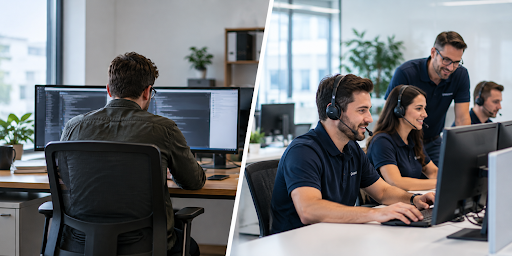
What Is In-House IT?
In-house IT is your own people running your technology, anywhere from one capable all-rounder to a full internal team. The draw is presence. Someone is physically there, learns your systems and your staff, and has the business's interests at heart because it signs their paycheque. For anything that needs real context, that closeness is hard to match.
The cost is bigger than the salary line suggests. An experienced IT professional in Australia earns a full-time wage plus superannuation, leave, training, and equipment, and even then one person can't be genuinely expert across helpdesk, security, cloud, networking, and strategy at once. You either live with the gaps or hire a second person, and that second hire is another whole salary, which is why in-house cost tends to jump in big steps rather than scale smoothly.
What Is Outsourced IT?
Outsourced IT means paying an external provider to run some or all of your technology, usually for a predictable monthly fee. In its most complete form this is fully managed IT services, where the provider acts as your entire IT department.
The appeal is range and predictability. Instead of one person's skill set, you get a team that collectively covers helpdesk, security, infrastructure, and planning, for a cost you can budget to the dollar. Nobody takes leave that leaves you exposed, and the provider carries the burden of staying current.
The cost is distance. The provider isn't sitting in your office, so responsiveness and the quality of the relationship matter enormously, and there's no single internal person whose whole world is your business. A good provider closes that gap with documentation, regular reviews, and fast support, but it's the real trade-off to weigh.
In-House vs Outsourced IT Compared
| Comparison | In-House IT | Outsourced IT |
|---|---|---|
| What you pay for | Salaries, super, leave, training, equipment | A set monthly fee |
| Range of skills | Limited to who you employ | A whole team's breadth |
| Cost pattern | Large, lumpy steps as you hire | Predictable, scales in small steps |
| Business knowledge | Deep and internal | Built over time, held externally |
| Cover for leave / after-hours | Gaps unless you hire more | Handled by the provider |
| Best suited to | Tech-centric or large organisations | Businesses where IT must work but isn't the product |
The Real Cost of In-House vs Outsourced IT
Comparing a salary against a monthly fee is the obvious move, and it misleads in both directions.
In-house looks cheaper than it is because the wage is only the visible part. A single mid-level IT hire in Australia runs to roughly $80,000 to $110,000 a year in salary alone, and once you add super, leave, training, recruitment, and software, the real cost sits well above the headline. It also buys one person's range, not a team's.
Outsourcing looks dearer than it is because the monthly fee is the whole cost, with a team's breadth already inside it, no recruitment, no leave cover to arrange, no training budget. For most small-to-mid businesses, managed IT pricing lands around $120 to $250 per user per month. For a ten-person business that's a fraction of a single IT salary, for the range of a whole team.
The fair comparison isn't salary against fee, it's total cost against total capability. Do that honestly and outsourcing wins for most businesses below a certain size, while in-house starts to pay off once you're large enough to keep a specialised team genuinely busy.
When In-House IT Is the Better Choice
In-house is the stronger choice when technology is core to what you build and sell, not just what keeps the lights on. A software company, a business with heavy custom systems, or one where IT is a competitive advantage benefits from deep internal knowledge that a provider can't replicate.
It also suits organisations large enough to keep a team genuinely busy and specialised, where the volume of work justifies the fixed cost and there's enough variety that people can develop depth rather than spreading thin.
When to Outsource Your IT
Outsourcing is the stronger choice for the far larger group of businesses where IT is essential but not the product. If technology needs to work reliably and securely without being something you want to build a department around, a provider usually gives you that for less than the cost of doing it yourself.
It's especially strong for small and mid-sized businesses, where a single in-house hire can't cover the range you need and a second is out of budget. It also suits any business that wants predictable cost, no single point of failure, and access to specialists, security, cloud, infrastructure, on demand rather than on payroll.
Combining In-House and Outsourced IT
The framing of "hire or outsource" is a little false, because the most common answer in practice is both.
A business with no IT often starts fully outsourced, hires its first internal IT person as it grows, and then keeps the provider on in a support role rather than letting them go. The internal person handles the day-to-day and the business context; the provider covers the specialist work, the after-hours cover, and the projects one person can't absorb.
That middle ground is co-managed IT services, and for a business that already has, or is about to hire, an internal IT person, it's usually the most realistic answer of the three. The real choice between running everything externally and splitting it is co-managed versus fully managed IT.
How to Choose Between In-House and Outsourced IT
Size is the clearest starting point. As a rough rule, businesses under about 50 staff tend to find outsourcing wins on cost and breadth, since one hire can't match a provider's range and a second rarely fits the budget. Past that, and especially where technology is core to what you sell, an internal team starts to pay for itself. Beyond size, a few things decide it:
- Downtime cost: If an hour offline means lost revenue, not just inconvenience, you need coverage a single employee can't guarantee through leave and sick days.
- Operating hours: A business running evenings or weekends needs after-hours support built into an agreement, which one internal person can't provide alone.
- Sensitive data: Holding client or health records raises the security bar past what a generalist hire usually maintains, and outsourcing your IT doesn't outsource your legal responsibility for that data under the Notifiable Data Breaches scheme.
- Budget predictability: A salary shifts with hiring, leave, and turnover, where a monthly fee stays flat and scales in small steps.
- How central IT is: If technology is the product, in-house depth is worth building; if it's the plumbing behind the business, outsourcing usually gives you more for less.
Work through those and most businesses land somewhere clear. No internal IT and a need for range without building a department points to outsourcing. Technology central to the business, and enough scale to keep a team busy, points to in-house. A capable person already stretched too thin is the classic case for the co-managed middle.
Frequently Asked Questions
Is outsourced IT cheaper than in-house?
Often, for small and mid-sized businesses, because a monthly fee buys a whole team's range without salaries, super, leave, and training. The fair comparison is total cost against total capability, not salary against fee.
What's the main advantage of in-house IT?
Presence and context. An internal person knows your business intimately and is on-site, which suits organisations where technology is core to what they do or large enough to keep a specialised team busy.
What's the main advantage of outsourced IT?
Range and predictability. You get a team's breadth of skills, no single point of failure, and a cost you can budget precisely, without recruiting or training.
Can I have both in-house and outsourced IT?
Yes, and many businesses do. Co-managed IT keeps an internal person and adds an external provider alongside them, combining internal context with external range.
When should a business hire its first IT person?
Usually when the volume and complexity of IT work justifies a full-time salary and there's enough business context that having someone in the building adds real value. Many keep a provider on afterwards rather than replacing it.
Does outsourcing mean losing control of our IT?
Not with the right arrangement. Fully managed hands over the running of IT while you keep the decisions; co-managed keeps control firmly in-house. Control is about how the arrangement is set up, not outsourcing itself.
Working Out What Fits
If technology is central to your business and you're large enough to staff it, in-house depth is worth the cost. If IT needs to work reliably without becoming a department of its own, fully managed IT services gives you the range for less than hiring. And if you already have someone who's stretched, co-managed IT services keeps them and fills the gaps.
Where Techware Fits
Techware can talk it through against your actual size and setup, and say plainly which of the three fits, across Australia.
